
Back a side, lay a side
Play in Match Exchange — Bookmaker, Over Runs and Tied Match Markets, Real Lay Odds
Play in Match Exchange lets you pick the outcome you expect and back it, or pick the outcome you doubt and lay it, with ₹100 as the smallest ticket. Your money is matched against another PlayinMatch member holding the opposite opinion. Have the username from the WhatsApp desk ready, choose a cricket fixture, then tap a price.

Fast PlayinMatch Exchange Sign-In Before Your First Lay
Back or Lay on Play in Match From ₹100 Your first PlayinMatch exchange bet can be as small as ₹100 once the 24x7 desk has issued your ID on WhatsApp; 18+ only.How Back and Lay Work on the Official PlayinMatch Exchange
Every PlayinMatch exchange bet starts with a yes or a no. Saying yes is backing: you want India to win, the scores to finish level, the batting side to clear a run line. Saying no is laying, and it flips your seat at the table, because you now hold the bookmaker's job of accepting another member's yes, collecting their stake if the outcome misses and paying them if it comes true.
Who is across the table from you? On the PlayinMatch exchange it is a fellow member with the opposite opinion. On the sportsbook it is the site, at a fixed price it set. Either way the ticket is paid from, and into, one wallet.
That shared PlayinMatch wallet matters more than it sounds. You do not need a second account, a second deposit or a second password to switch between the two, and anything you win on a lay bet in the afternoon sits in the same wallet you use for a fixed-odds bet at night (or for a live casino seat, if that is your thing).
Why would anyone lay at all? Because sometimes the cleanest opinion you hold about a match is a negative one, for example that the side everbyody is backing is overpriced, that a tie will not happen, or that a chasing team will not get over a session line in the first six overs, and the PlayinMatch lay column is the only place where you can put money directly on that view.
A short version for the impatient PlayinMatch newcomer. Back means yes. Lay means no.
Quick First Trade on PlayinMatch Exchange, Step by Step
Most people arrive at this page with an ID already in hand. If you do not have one yet, the PlayinMatch joining steps cover the WhatsApp request: you send a name and a mobile number, and the username comes back usually inside 4 minutes.
- Use the PlayinMatch login page first; either the desk username or the phone number registered on the ID goes in the top box, your password below it.
- Open the exchange from the dashboard. Three tabs sort the fixtures: In-Play for matches running now, Today, and Upcoming.
- Pick a cricket match. A LIVE badge marks the ones already under way, and the score card sits inside the market itself.
- Decide yes or no on the outcome. Yes means the back column, no means the lay column; the figure you touch is copied into the PlayinMatch slip, so the only thing left to type is rupees.
- Type your stake. The PlayinMatch exchange accepts ₹100 or more; anything lower will not go through.
- Place it. The ticket now waits in My Bets on PlayinMatch, the same screen where its win or loss is written after the market closes.
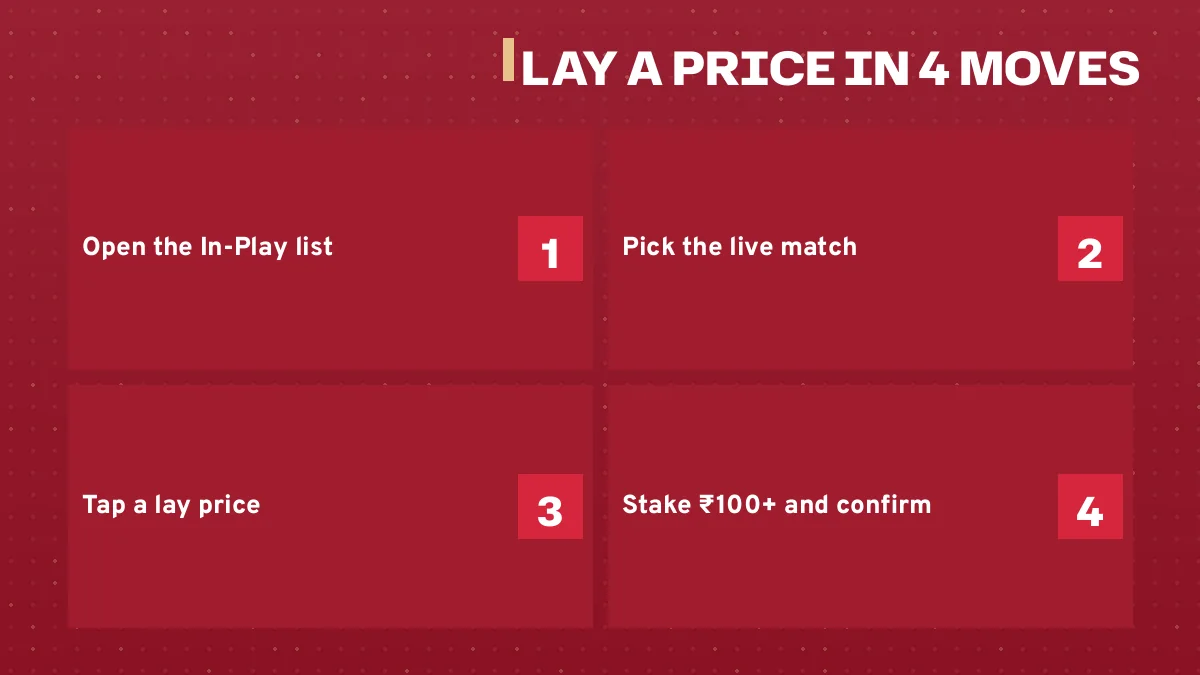
The whole sequence takes about as long as reading it. What slows people down in practice is step five, because a first-timer often types ₹50 out of caution and then wonders why the slip refuses it; the ₹100 floor applies to every exchange market on PlayinMatch, cricket or otherwise.
Want to look around before risking a rupee? Ask the desk for a demo ID. It carries a practice balance in points, no real money, so you can tap back and lay prices on PlayinMatch and watch how the slip behaves.
Worked Back and Lay Ticket: Simple PlayinMatch Exchange Maths
Numbers make this click faster than definitions do. The ticket below uses an illustrative price of 1.80 on one team in a match odds market and the PlayinMatch minimum stake of ₹100. The price is an example for the arithmetic, not a quote from a live market.
| Ticket line | Back ₹100 at 1.80 | Lay ₹100 at 1.80 |
|---|---|---|
| What you are saying | This team will win | This team will not win |
| Money held from your balance | ₹100 (your stake) | ₹80 (your liability) |
| If the team wins | You collect ₹80 profit plus your ₹100 back | You pay ₹80 to the backer |
| If the team loses or the match goes elsewhere | You lose the ₹100 | You keep the backer's ₹100 |
| Where the result shows | My Bets, after PlayinMatch settles the market | |
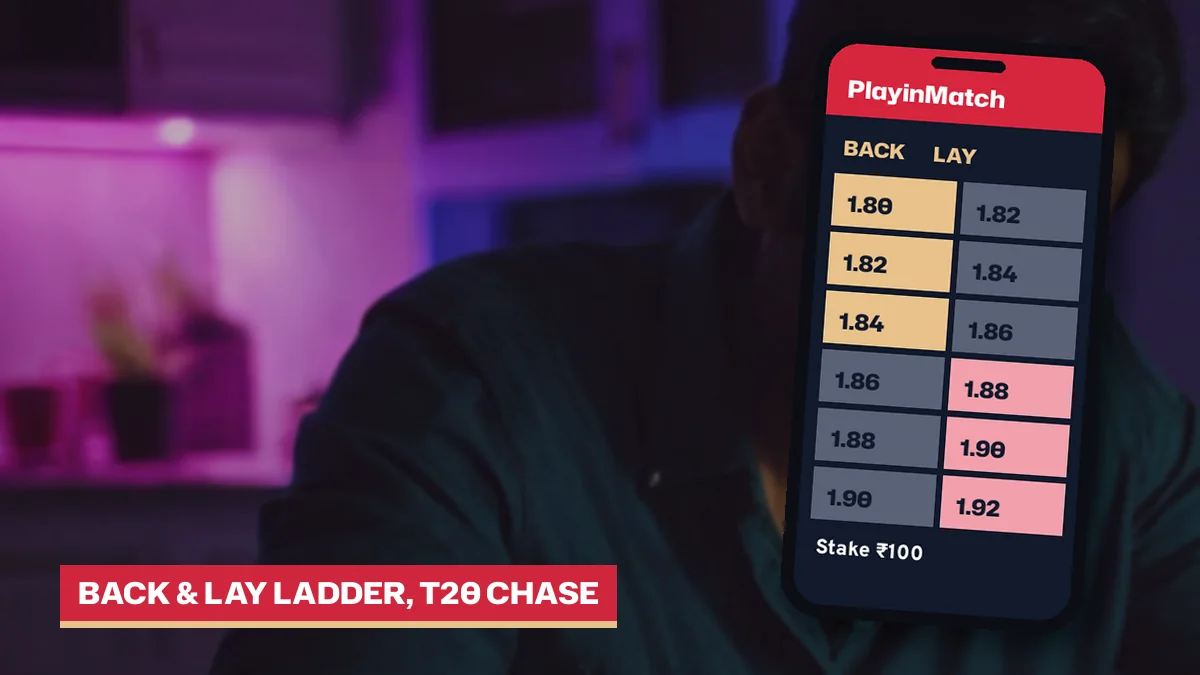
Most first lays on PlayinMatch go wrong on liability. Laying ₹100 at 1.80 does not put ₹100 at risk; it puts the backer's potential profit at risk, and that is 0.80 of the stake, so ₹80 is held. The higher the price, the heavier the hold: a ₹100 lay at 2.50 ties up ₹150, the sum you would owe if that runner won.
Rule of thumb for any PlayinMatch lay: liability = stake × (price − 1). Make sure your balance covers it before you tap.
So a lay at a short price is cheap to place. A lay at a long price is not.
Locking in a PlayinMatch result: back early, lay later
Here is the trading move in numbers, again with example prices. Before the first ball you back a team for ₹100 at 2.00. They start well, and an hour later the same team trades at 1.60 on the PlayinMatch exchange. You now lay them for ₹100 at 1.60, which holds ₹60 of liability.
- Favourite wins the game: ₹100 earned on the 2.00 back, less ₹60 handed over on the 1.60 lay, leaves ₹40 in the wallet.
- Favourite falls short: the 2.00 back is gone, but the backer you laid hands you their ₹100, which cancels it to zero.
No outcome loses money from that point on. That is the whole appeal of having both columns on one PlayinMatch market, and it is something a fixed-odds sportsbook simply cannot offer, because there is no lay column there to close the position with.
One more line on that ticket deserves a mention. If you back and later lay the same team at a different price, you can lock in a result either way; that is the basic idea behind trading on an exchange, and PlayinMatch lets you do it because both columns stay open on the same market for as long as it is running.
Cricket Markets on Play in Match Exchange: The Full Live List
Six market types cover nearly everything people come to the PlayinMatch exchange for. Each one asks a different question about the same match, and the prices in each move on their own schedule.
- Match odds
- The winner question in its plainest form, and the market used for the ₹100 ticket above. On PlayinMatch both teams carry a back and a lay figure here.
- Bookmaker
- A second winner market with its own rates, listed beside match odds so you can compare the two before you commit.
- Fancy and session runs
- A run target for one portion of an innings. You side with the batting team clearing it or falling short, and PlayinMatch settles it when that portion ends.
- Over runs
- Runs in a single over. Short, quick and settled within minutes of the over finishing.
- Toss
- The earliest PlayinMatch line to settle: the coin decides it, so a toss ticket is cleared in My Bets before the opening over begins.
- Tied match
- Whether the scores finish level. Most people lay this one; backers are hoping for the rare finish.
Bookmaker deserves a second sentence. On PlayinMatch it sits close to match odds and answers the same winner question, yet the rate can drift away from the exchange price during a tight chase, which gives you two places to look before you put money on a side. Worth a glance.
The tied match market works almost like insurance for some users. If you have backed one side in a close game and want to cover the thin chance of a tie, a small back on the tie line is one way to do it; equally, laying the tie on PlayinMatch is a common way to pick up the backer's stake on a market that settles in your favour far more often than not, as long as you are comfortable with the liability on the price shown.
Session and Over Runs: Fast-Moving Markets on PlayinMatch
If the match odds ticket is a single verdict on the whole game, session trading on PlayinMatch is dozens of smaller verdcits strung through one innings. Each line is a run total for a slice of overs, and your stake rides on the batting side getting past it or not.
Picture a powerplay line on a T20 chase. Openers timing it well and a bowler leaking width point you towards the over side; a slow surface and a wicket in the previous over point you the other way. Every boundary and every dot ball pushes the figure, so PlayinMatch session traders keep the score card that lives inside the market open and wait for the swing they want instead of firing at the first number they see.
Session and over-run figures in this section are examples of how the market reads, not live lines. The actual line for any match is the one you see in the PlayinMatch market at the moment you tap.
Over runs are shorter still. One over, six legal balls, one number. They settle almost as soon as the over ends, so the result lands in My Bets within minutes and the stake can go straight into the next over. Brisk stuff.
A practical point about both markets: they open and close around the live action, so a line you saw a minute ago may already have shifted or been taken down while the PlayinMatch exchange waits for the next ball, and the right reaction to that is to reopen the market rather than retry an old slip.
Choosing between the two is mostly about patience. A session bet on PlayinMatch gives a spell of overs for your read to play out, so one wild delivery does not decide it; an over-run bet is decided by six balls and a single big hit can swing it either way. People new to the PlayinMatch exchange often start with a session line in a T20 they are already watching, then try over runs once they have a feel for how quickly the figure moves.
Exchange or Sportsbook: Picking the Best Side of One PlayinMatch ID
A rupee in your PlayinMatch wallet does not care which tab spends it. The real choice is about control: seting your own side, including the side that says no, or accepting a price somebody else fixed.
| Point | PlayinMatch exchange | PlayinMatch sportsbook |
|---|---|---|
| Who takes the other side | Another user | The site, at fixed odds |
| Can you lay | Yes, on every market listed | No, back only |
| Minimum stake | ₹100 | Shown on the bet slip |
| Balance used | The same PlayinMatch wallet | |
| Results | My Bets, after the market settles | |
If you only ever back favourites, the sportsbook does the job and you will hardly notice the difference. The exchange earns its place when you want to oppose an outcome, when you want to trade in and out of a position during the match, or when you want to compare the PlayinMatch bookmaker rate against the exchange price before deciding where to put a stake that you have already sized up from your balance.
Take one opinion and run it through both. Say you think the side batting first in an IPL game will lose. On the sportsbook you would back the other team at whatever fixed price PlayinMatch quotes. On the exchange you have a second route: lay the side you doubt, and your ₹100 stake works against them directly, with the liability set by the price on screen. Same view, two instruments, and the better choice depends on which price looks fairer to you at that moment.
Switching costs nothing. Same ID, same rupees.
IPL, Tests and Domestic Cricket: Where PlayinMatch Exchange Is Busiest
Here is something the worked ticket does not show. A lay stays open, with its liability parked, until its market settles, and on PlayinMatch that can mean a few minutes for an over-run line in an IPL game or several days for a tied-match lay in a Test. Domestic games, ODIs and overseas T20 leagues fall somewhere in between, so the format you pick decides how long a slice of your wallet sits locked.
Tests behave differently from T20 games on an exchange. A five-day match leaves room for the tied market, the winner price and session lines to swing for days, while a T20 can turn on one over; PlayinMatch users who trade Tests tend to hold positions longer, and the ones who prefer the IPL tend to work session runs and over runs in short bursts.
Filter by time first. In-Play shows what is running right now on PlayinMatch, Today shows the rest of the day, and Upcoming holds the fixtures further out.
Lay a favourite in a Premier League game or back a Pro Kabaddi raider at a price you set: the exchange grid works the same outside cricket. The PlayinMatch live sports list covers which of them run in play. Virtual cricket also cycles round the clock in short rounds for the hours when no real match is on.
When a match ends, PlayinMatch settles each market and the outcome appears in My Bets. Toss settles first, over runs settle over by over, sessions settle at the end of their stretch, and match odds, bookmaker and tied match settle with the final result. Different clocks.
Trusted Money Flow Around Your PlayinMatch Exchange Balance
The exchange draws on the same balance as everything else on PlayinMatch, so the money side is short to explain. A deposit starts at ₹200 by UPI, IMPS or bank transfer from an account in your own name; post the reference to the desk and the balance usually shows within about 5 minutes. At ₹100 a stake, that minimum deposit covers two exchange bets, or one back plus the liability on a short-priced lay.
Winnings come out to the same bank account or UPI handle that is in your name, with a ₹500 minimum. Timing varies with bank hours, and the PlayinMatch withdrawal time page lays out the normal window and what causes delays.
- Tap a lay at 2.50 for ₹100 and ₹150 leaves your available PlayinMatch figure at once; it comes back, plus the backer's stake, if that runner fails.
- Settled winnings go back into the PlayinMatch wallet; they do not leave it until you request a withdrawal.
- Back stakes and lay liabilities come off the same figure, so two open lays on one match can tie up more of a ₹200 deposit than a newcomer expects.
Common snags, and what usually fixes them:
- The slip will not accept my stake
- Two usual causes on PlayinMatch: an amount under ₹100, or a lay whose liability is larger than what is free in the wallet after earlier tickets.
- The market vanished mid-tap
- Live lines close and reopen around the action. Reopen the match and take the current price.
- The address will not open
- An ISP block on one PlayinMatch address does not touch your open bets. Switch to another mirror the desk sent you, or to the app, and the same ID shows the same balance and the same My Bets list.
- My result is not showing
- Look in My Bets after the market is settled. Session and over-run results appear well before the match result does.
Anything else goes to the 24x7 WhatsApp desk on +91 81097 11726. First replies usually come within about 5 minutes; have your username, the amount and the time of the bet or payment ready.
- play in match exchange
- playinmatch exchange
- playinmatch exchange review
- playinmatch exchange withdrawal
- play in match exchange cricket
- playinmatch lay bet
- playinmatch session bet kaise lagaye
- playin match exchange login
PlayinMatch Exchange Questions, Answered Fast
What is the minimum stake on the PlayinMatch exchange?
₹100 is the smallest ticket PlayinMatch accepts on the exchange, back or lay. For a lay, the wallet also has to hold the liability: stake times the price minus one, so ₹80 on a ₹100 lay at 1.80. Type ₹99 and the slip simply refuses it.
Where do I see the result of a PlayinMatch exchange bet?
Results appear in My Bets once PlayinMatch settles the market. Toss and over runs settle early, session runs settle at the end of their stretch, and match odds, bookmaker and tied match settle with the final result. Winnings go back into the same wallet you used to place the bet.
How do I withdraw my PlayinMatch exchange winnings?
Request a withdrawal of ₹500 or more to the bank account or UPI handle in your own name. On a normal day it usually lands in 15 to 45 minutes, while bank holidays, server downtime or late-night IMPS queues can stretch that to a few hours. Keep the UTR the desk sends you.
What do PlayinMatch exchange reviews mostly complain about?
Public reviews mostly mention withdrawal delays. The usual causes are a name mismatch between the ID and the bank account, an unfinished bonus turnover, or a request raised during bank downtime. If a payout shows as paid but has not arrived, the UTR from the desk is your proof for the bank.
Can I try the PlayinMatch exchange without real money?
Yes. Ask the 24x7 WhatsApp desk to switch on a demo ID, which carries a practice balance in points rather than rupees. You can tap back and lay prices, see how liability is held and watch bets settle before you deposit the ₹200 minimum for real stakes.
Play in Match Exchange Keywords on One Verified Page
What play in match exchange means on this back-and-lay page
Searchers typing play in match exchange want the side of PlayinMatch where users set prices against each other. This page covers that market, from the ₹100 stake to the lay liability sum.
Why playinmatch exchange is spelled several ways here
Playinmatch exchange, PlayinMatch exchange and Playin Match exchange all point to one product. The ID, wallet and markets are identical whichever spelling brought you in.
Markets the playinmatch exchange lists for cricket
- Match odds and bookmaker
- Fancy and session runs, over runs
- Toss and tied match
Play in match exchange figures used in the worked ticket
| Item | Figure |
|---|---|
| Minimum exchange stake | ₹100 |
| Minimum deposit | ₹200 |
| Minimum withdrawal | ₹500 |
The three rupee figures in this table are the ones the worked ticket leans on; the fourth thing to remember, the lay liability sum, is spelled out in the band section further up this PlayinMatch exchange page.